It’s not just for the students and teachers: Another perspective on privacy

Target was targeted. [image credit: ask.com]

A colleague of mine recently sent me a link about a Common Sense Media statement about the weak state of data privacy in schools. The main idea behind the statement (summarized here by NPR) is that schools are doing a less than stellar job protecting the privacy of their students’ data. This article piqued my interest since we here at AES have recently dealt with a few hacking/privacy issues. This recent issue has made me look at all of our policies and agreements around privacy and student/family data. As a result I’m starting the process of doing an informal security audit. So far I am finding the deeper I dig, the more areas there are to investigate. I am working through our business office, facilities management office, and of course the main tech office and beyond. There are so many systems here at AES that it will take some time to complete even this informal audit. I’m already feeling like I am going to need an 3rd party to complete a security audit.

The first place I looked is at our school information system, Veracross. Here’s a copy of the privacy agreement (a section of our contract with them)

6. Intellectual Property
B&C shall retain all right, title and interest in and to the B&C Technology and the System, and Client shall retain all right, title and interest in and to the Client Data.
7. Confidential Information
(a) Each party acknowledges that it will have access to certain confidential information of the other par- ty concerning the other party’s business, plans, Clients, resellers, technology, and products, and other information held in confidence by the other party (“Confidential Information”). Confidential Information will include all information in tangible or intangible form that is marked or designated as confidential or that, under the circumstances of its disclosure, should be considered confidential. Confidential Information will also include the Database, Client Data, and the B&C Technology. Each party agrees that it will not use in any way, for its own account or the account of any third party, except as expressly permitted by, or required to achieve the purposes of, this Agreement, nor disclose to any third party (except as required by law or to that party’s attorneys, accountants and other advisers as reasonably necessary), any of the other party’s Confidential Information and will take reasonable precautions to protect the confidentiality of such information that are at least as stringent as it takes to protect its own Confidential Information. Within 30 days after termination of this Agreement, each party shall return to the other party (or, at that party’s option, destroy) all Confidential Information of the other party then remaining in its possession.
(b) Information will not be deemed Confidential Information hereunder if such information: (i) is known to the receiving party prior to receipt from the disclosing party directly or indirectly from a source other than one having an obligation of confidentiality to the disclosing party; (ii) becomes known (independently of disclosure by the disclosing party) to the receiving party directly or indirectly from a source other than one having an obligation of confidentiality to the disclosing party; (iii) becomes publicly known or otherwise ceases to be secret or confidential, except through a breach of this Agreement by the receiving party; or (iv) is independently developed by the receiving party. The receiving party may dis- close Confidential Information pursuant to the requirements of a governmental agency or by operation of law, provided that it gives the disclosing party reasonable prior written notice sufficient to permit the disclosing party to contest such disclosure.

Do you like the fine print? 🙂 It basically states that we agree to keep what we know about Veracross’s software and processes private and they agree to keep our data private. The main issue for me is, what happens if they don’t keep our data private? History shows that even major companies cannot keep their data private, right? I think the only thing going for Veracross and AES is that overall there is not a high demand for our data. Credit card information from Target is simply worth more on the black market.

Honestly data security is not something that I thought much about before signing a contract with Veracross. Yes, I did read the contract, but I never once asked them about the real world practices of their company that are in place to protect our students’ data. It’s something that I need to do for all of our systems, but it takes time. Once you start digging into these issues, you feel like you are going to need a personal data security specialist (and a lawyer) to complete the process! We cannot afford to ignore it however. As a school, we are, in the end, responsible for the data we maintain. So I suggest we need to expand the discussion beyond just personal privacy for students and teachers to the privacy of the data housed in our systems at school. This of course hits home to me as the Director of Technology at AES. Now that I have opened this can of worms I will have to deal with it. Looks like I have some work to do!

The Power of the Link

http://www.flickr.com/photos/dieselbug2007/

Thanks to Flickr user dieselbug2007

The year was 1998. It was my first year in Kenya and I was teaching 7th grade science, HS Physical Science, Auto Mechanics and Computer Applications. I was also working on the tech team. We had a dial-up connection to Nairobi that was used exclusively for email. Yes you could access the Internet via a dial up connection as well, but the speed would be extremely slow (9600 bps on a good day) and the typical phone call to Nairobi was disconnected every 5 minutes. Even our mail server connection was constantly getting bumped offline and having to re-dial the main server in Nairobi.

The Internet was not fast where my wife and I had come from in Kentucky, especially compared to today’s speeds that are approaching 100Mbs for residential connections (much faster where fiber exists), but at least it you could keep a persistent connection. Yes moving to Kenya was a tough transition, especially for a techie. I remember teachers driving to a little Internet cafe in Nairobi and downloading copies of websites. I did it myself several times. We’d download a whole site (and as many linked pages as were possible using a web crawler app) and then upload it to a local web server on campus back in Kijabe, Kenya. We’d then talk kids through this sort of surreal experience of the “fake Internet”. Lots of the links on the home page worked but anything beyond a one layer deep was typically broken.

Imagine yourself browsing the web tonight. You do a quick search for “tech conferences in Africa”. An appealing list of upcoming events pop up in the results. You click on the top hit, but it takes you nowhere. Instead you get an error reporting that “This browser supports only one level of hyperlinks”. Frustrated you click <back> and search for “error: this browser supports only one level of hyperlinks” hoping, of course, to find a solution. The third hit looks appealing, “SOLVED!: This browser supports only one level of hyperlinks ERROR”. You click optimistically on that link, but of course that dreaded error comes back! It all sounds like a bad dream because we are so accustomed to the power of the link.

The power of the link. It’s a simple power, but it’s what makes the web so amazing. Without it, you are alone on an island. (Okay maybe stranded on an island with some other  people) It’s a power we are all accustomed to; those of you who are reading this blog at least. Today it’s hard to imagine being able to do my job without all those hyperlinks working! But not only do I have thousands of answers at my fingertips, but I have the power of ideas at my fingertips too. In the beginning it was answers/information we were all excited about finding. Reading the news. Finding a lost instruction manual online. Things like that. But now we are realizing the real power of the link. The power that keeps growing with every click. It’s the sharing of ideas. It’s the limitless learning. Powers like those are powers of connection. And human connections are still fundamental to the way we live. It’s just as true today as it was back in Kenya and before the world wide web. So go on, click something and connect yourself to ideas, to people, to the world.


Flappy Bird and hard work

Flappy Bird - Dong Nguyen © 2013 .GEARS Studios

Flappy Bird – Dong Nguyen
© 2013 .GEARS Studios

Surely you’ve seen the new number on app, “Flappy Bird”. It’s rise to number one has taken 6 months, and for good reason: it’s hard. VERY hard. It’s that difficulty that makes it so fascinating to me that it has reached #1 on both the Apple App Store and the Google Play store. (as of Feb. 3, 2014) It’s rise to #1 proves that people like hard work. It’s satisfying to work really hard, trying over and over again to make it through those menacing pipes. I admit, it is also a little frustrating! The first couple of times I played I thought I was doing something wrong actually, but it is just plain hard. I love that people enjoy the difficulty and have taken the challenge head on. Scores like “20” are something to be proud of. In fact when you get past the first pipe you jump for joy!

It’s just one more piece of evidence that supports the growing body of evidence about how good games can be good for our students. Working really hard to get a decent score in Flappy Bird shows grit, determination and perseverance. Sure, it’s just a goofy bird that does not fly very well, but in the end that little Flappy Bird teaches us to hold on, keep trying and in the end we maybe, just maybe will get through more than one of those pipes. Go on, download it and see if you don’t agree with me.

Flappy Bird on Google Play

Flappy Bird on Apple’s App Store

Who is David Beaty?

This NOT the real David Beaty!

This NOT the real David Beaty!


Actually I am not sure any more. I used to know who David Beaty was but now I am not sure. It’s nothing I did really, it’s more like something I did not do, or actually, more like something someone else did. Allow me to explain…

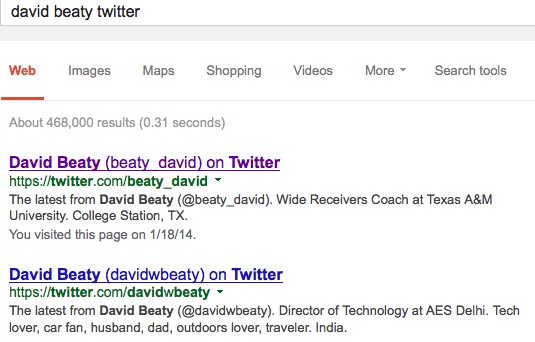
A few years back if you did a Google search for the terms “David Beaty” you would see an author by that name and me, the “real” David Beaty. Today, when I Google myself, I see the author and another David Beaty who has, over the past two years, been working as a Texas A&M football coach. Of course, he was alive a few years ago when I had his “spot” in the first page of Google search results, and in fact he was coaching other college football teams in other states. There is one major difference however; his new employer (Texas A&M) clearly has a strong online presence. They post a massive amount of content online. Like an increasing number of institutions and companies, they may actually require their coaches to have a social media profile in addition to the regular content the school publishes. They may have a social media consultant or even someone whose full time job is to manage web presence for their teams and coaches. This “other David Beaty” also may have taken a personal interest in social media. Perhaps during his job hunt (before the Texas A&M job), as people recommend, he investigated and improved his digital footprint. Whatever the reason, I, the “real” David Beaty, have been demoted to the world of “not-the-first-page Google results” where no-one bothers to look.

Honestly I thought I was doing it right. I am on most of the social media sites, Pinterest, Twitter, Facebook, LinkedIn, Instagram and others. In fact I even own my domain (davidbeaty.com) and have claimed davidbeaty.wordpress.com, etc. Many years ago I tried to claim davidbeaty@gmail.com, but without any luck, so I went with my second choice, davidwbeaty@gmail.com. My point is I do technically own my “digital space” in some of the major social media websites, but it is not enough. Increasingly I am realizing that to bolster your digital footprint you need to actually get your name mentioned and your content distributed on the web. I’ve come to this conclusion because that is the one major difference between the “other” David Beaty and me, the real David Beaty 🙂 Because of the size of Texas A&M his name and images get published frequently. It’s not that he simply owns his “name space”. It’s the sheer volume of content out there on the web related to him.

Let’s also keep in mind that different search engines have vastly different results. I had assumed, as many people do, that Google may have slightly different search results than other search engines. I also assumed that “slightly different” also meant “slightly more”. With these assumptions in mind you can see why I was surprised to know that Yahoo has me on page one. That’s right I am on page numero uno of Yahoo search results for David Beaty. In fact, if you removed the ads and image search results I am the 4th hit on Yahoo! The same is true on Duck Duck Go: 4th from the top.

I am also learning that Google does not serve up as much social media results as I would have guessed. Many of the top hits are not Facebook or LinkedIn or Pinterest or Instagram pages, they are basic web pages (Twitter does seem to be on the first page of results fairly often). This may be due to the fact that Google has a harder time getting into those pages to do deep searching, or it may be related to the fact that Google has it’s own social networking site, Google+. I suspect a little bit of both factors are at play.

How can teachers and students benefit from my experience (aka my demotion to page X of Google’s search results)? The message for students and teachers here is that it is not enough to own your digital name plate, you have to have content. It’s obvious to me that I need to do more than just own my own domain and have accounts on social networks.

Here’s a summary of my suggestions for educators:

  1. Own your domain (ex. davidbeaty.com) or something that represents your “brand”.
  2. Create accounts on social media websites like LinkedIn, Facebook, Pinterest, Twitter, blogs, etc.
  3. Get your content out there on as many platforms as possible. This may mean that you use a tool like IFTTT to double or triple post your content. For example, when you tweet something, you can simultaneously post that tweet to your WordPress blog and update your Facebook status with the same content. Be careful, you don’t need to overdo it and sometimes a tweet just does not work as a blog post, but it does multiply your content very quickly and search engines care about volume of content!
  4. Post content often. If you don’t do it someone else will and they will control your web presence.


David Beaty vs. David Beaty on Twitter

David Beaty vs. David Beaty on Twitter


David Beaty Pinterest - Google Search

David Beaty Pinterest – Google Search – This one is the real me!

References:

The “Fake” David Beaty
twitter.com/beaty_david
www.aggieathletics.com/ViewArticle.dbml?ATCLID=205366779

 The “Real” David Beaty
davidbeaty.com
twitter.com/davidwbeaty
www.pinterest.com/davidwbeaty